How to Get AI to Recommend Your Business (ChatGPT, Gemini & Perplexity)

SEO Specialist
A few years ago, “getting found” meant ranking on page one of Google. Today a growing share of buyers skip the list of links entirely. They ask ChatGPT, Gemini, Perplexity or Google’s AI Mode a direct question, like “who’s the best roofer in Dallas?” or “which project management tool should a 10-person agency use?”, and they get a short answer that names two or three businesses. If yours isn’t one of them, you don’t exist for that buyer.
This guide explains how to get AI to recommend your business, based on what I do for clients and what the published research actually shows. No guarantees, no tricks, and no “secret prompts.” Just the signals AI systems use when they decide which brands to mention, and how to strengthen each one.
Key takeaways
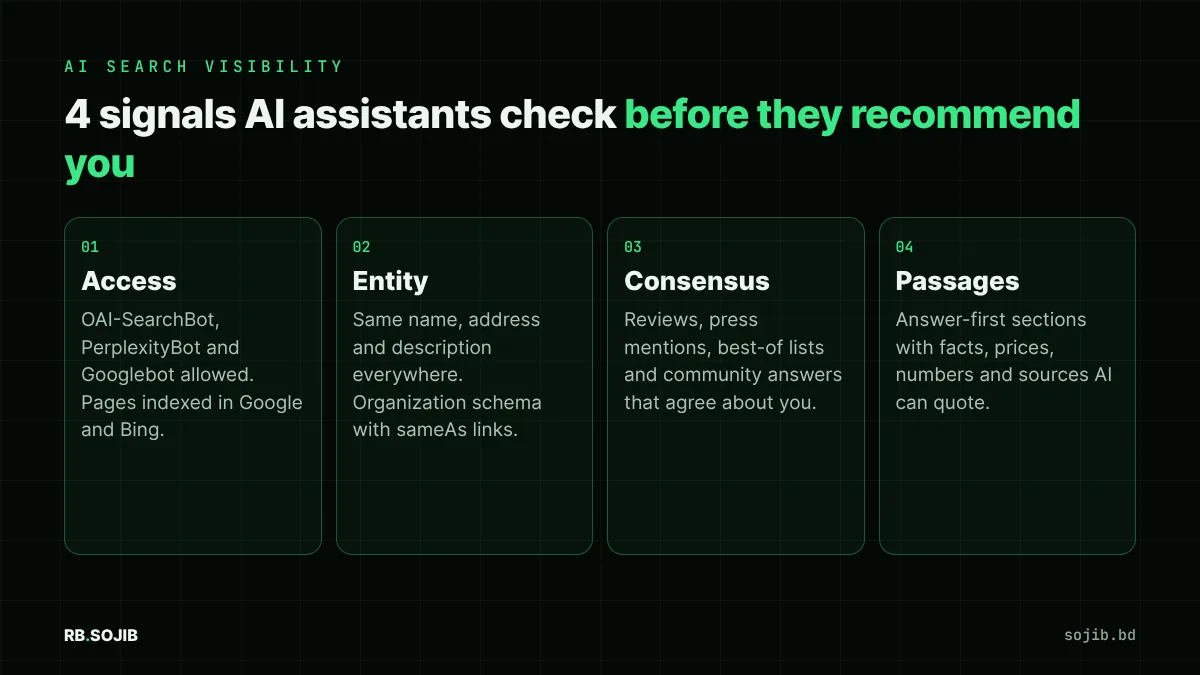
- AI assistants recommend brands they can find, verify and quote. That means crawlable pages, a consistent identity across the web, and independent sources that agree about you.
- ChatGPT search needs access. If your robots.txt blocks
OAI-SearchBot, or Bing can’t index you, ChatGPT can’t cite your pages in live answers. - Third-party mentions matter more than your own claims. Reviews, press, “best of” lists and community discussions build the consensus AI relies on.
- Write in quotable passages: a direct answer first, then facts, numbers and sources. Research on generative engines found these additions lifted visibility by up to 40%.
- Measure it. Track a fixed set of buyer prompts every month and record whether, where and how you’re mentioned.
In this guide: What does it mean for AI to recommend your business? · Why SEO alone isn’t enough (and why you still need it) · Step 1: Make sure AI can reach your site · Step 2: Build a clear, consistent brand entity · Step 3: Earn mentions AI trusts · Step 4: Write content AI can quote · How the playbook changes by business type · How to measure AI recommendations · AI recommendation checklist · Should you do it yourself or hire an expert? · Frequently asked questions · Sources and further reading
Free, with a written report.
Get my free auditWhat does it mean for AI to recommend your business?
When someone asks an AI assistant for a recommendation, the answer comes from two places. The first is what the model learned during training: patterns from millions of web pages, reviews and articles. The second is live retrieval: tools like ChatGPT search, Perplexity and Google’s AI features run real searches, read the top sources and summarise them, often with citations.
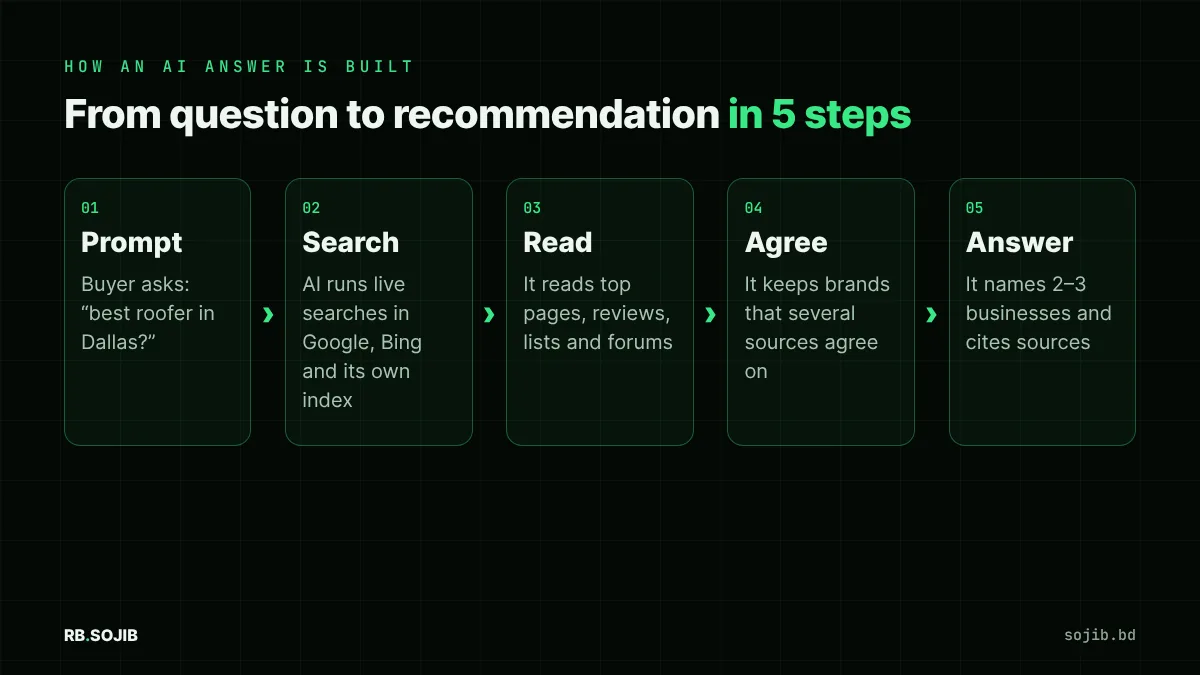
That gives you two jobs. In the long run, you want enough consistent, trustworthy information about your brand on the web that models “know” you. In the short run, you want your pages and your mentions to be the sources live retrieval pulls from. People call this GEO (generative engine optimization), AEO or AI SEO. The names differ; the work overlaps heavily with good SEO.
Why SEO alone isn’t enough (and why you still need it)
Classic SEO earns a position in a list. AI answers don’t show a list; they pick a few names and explain why. The table shows what changes:
| Traditional search | AI answers | |
|---|---|---|
| What the user sees | Ten links and ads | One written answer naming a few brands |
| What wins | Relevance, links, page quality | Being findable, verifiable and quotable across several sources |
| Your own website | The main asset | One source among many; independent mentions carry weight |
| Success metric | Rankings and clicks | Mentions, citations, sentiment and referral traffic |
But don’t throw SEO away. Live AI retrieval leans on search indexes, so pages that rank well are far more likely to be read and cited. Google’s own guidance says the same SEO best practices apply to AI Overviews and AI Mode. GEO is a layer on top, not a replacement.
The clearest evidence comes from the GEO research paper by Princeton and partner universities. The authors tested ways of rewriting content and measured how often it appeared in generated answers. Adding statistics, quotations and citations to credible sources improved visibility by up to 40%, while old-school keyword stuffing did little or nothing.
Step 1: Make sure AI can reach your site
This is the step most businesses miss, and it’s the easiest to fix. An AI assistant can’t recommend pages it isn’t allowed to read.
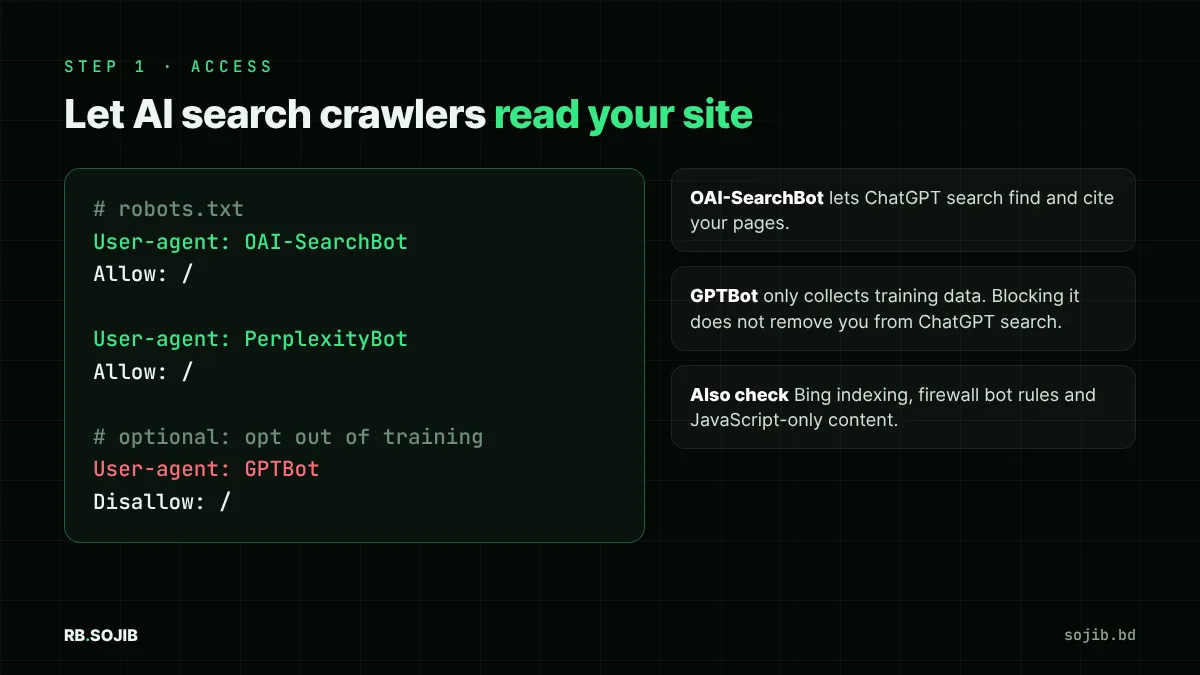
- Allow AI search crawlers in robots.txt. ChatGPT search uses
OAI-SearchBot; Perplexity usesPerplexityBot. BlockingGPTBot(training) is a separate choice and doesn’t remove you from ChatGPT search. See OpenAI’s crawler documentation. - Get indexed in Bing as well as Google. ChatGPT search draws on third-party search providers, and Bing is a major one. Verify your site in Bing Webmaster Tools and submit your sitemap.
- Put key content in the HTML. Most AI crawlers don’t run JavaScript. If your services, prices or reviews only appear after scripts load, they’re invisible.
- Check your firewall. Some security plugins and CDNs block “unknown bots” by default, which quietly shuts out AI crawlers.
- Add an llms.txt file (optional). It’s a short Markdown summary of your business and key pages, proposed at llmstxt.org. Adoption by AI companies is unconfirmed, so treat it as a cheap extra, not a ranking factor.
You can test the first four in seconds with my free AI search readiness checker.
Step 2: Build a clear, consistent brand entity
AI systems think in entities: a business with a name, a location, a category, people and relationships. If your details conflict from one site to the next, the model’s confidence drops, and low confidence means fewer mentions.
- Use one name, one description, everywhere. Same business name, address, phone and one-line description on your website, Google Business Profile, LinkedIn, directories and social profiles.
- Add Organization or LocalBusiness schema on your homepage with
sameAslinks to your official profiles, plus your logo, founder and service area. - Write a strong About page. Who you are, what you do, who you serve, since when, and what proof you have. AI pulls brand descriptions from here more than you’d think.
- Claim the profiles AI reads for your industry: Google Business Profile and Yelp for local businesses, G2 and Capterra for software, Clutch for agencies, Crunchbase for startups.
- Only use Wikipedia or Wikidata if you genuinely qualify. Both have notability rules, and entries created as marketing get deleted. Earn the coverage first.
Step 3: Earn mentions AI trusts
When an assistant decides which three roofers or software tools to name, it’s looking for agreement across independent sources. Your website saying you’re the best counts for little. Ten unrelated sources saying it counts for a lot.
- Grow genuine reviews on the platforms that matter in your niche, and reply to them. Volume, recency and rating all show up in AI answers.
- Get onto “best of” lists. Ask AI tools your buyers’ questions and note which articles they cite. Then pitch those publishers with something useful: data, a case study, an expert quote.
- Publish original data. A small survey or an analysis of your own job data gives journalists and bloggers a reason to mention you, and gives AI a fact to quote.
- Show up where your buyers talk. Helpful, non-promotional answers on Reddit, Quora and industry forums are part of the public record AI learns from.
- Fix wrong information fast. Old addresses, closed locations and outdated prices on third-party sites get repeated by AI. Correct them at the source.
Step 4: Write content AI can quote
AI assistants rarely quote a whole page. They lift a paragraph, a list or a table row that answers the question. Make those passages easy to lift.
- Answer first. Start each section with a one or two sentence direct answer, then explain.
- Use real numbers and sources. Prices, timelines, results, dates. Link to where the facts come from.
- Make each paragraph stand alone. Avoid “as mentioned above.” A passage that makes sense on its own is a passage that can be cited.
- Build comparison and pricing pages. Buyers ask “X vs Y” and “how much does X cost.” Honest pages that answer those questions get cited constantly.
- Show who wrote it. A named author with real experience, and a visible “last updated” date.
My on-page SEO checklist covers the page-level details, and the technical SEO audit checklist covers the crawl and rendering side.
How the playbook changes by business type
| Business type | What AI leans on most | Focus first |
|---|---|---|
| Local service (roofers, clinics, law firms) | Google Business Profile, reviews, local directories, city pages | Review volume, consistent NAP, service and city pages with real projects |
| SaaS and software | G2, Capterra, comparison articles, documentation | Comparison pages, public docs and pricing, review platform presence |
| Ecommerce | Product data, reviews, retailer listings, roundup articles | Product schema, review collection, inclusion in buying guides |
| Agencies and consultants | Clutch, LinkedIn, case studies, podcasts and interviews | Named case studies with numbers, expert content, directory profiles |
If you’re a roofer, I’ve written a dedicated guide to ChatGPT SEO for roofers. And if you’ve checked and your site doesn’t show up at all, start with why your website isn’t appearing in ChatGPT search.
How to measure AI recommendations
AI answers change from one conversation to the next, so a single check proves nothing. Measure like a researcher:
- Write 20 to 30 real buyer prompts, such as “best accountant for small businesses in Leeds” or “alternatives to [competitor].”
- Run them monthly in ChatGPT, Gemini, Perplexity and Google AI Mode, logged out where possible.
- Record mentions, position, sentiment and cited sources for you and three competitors. That’s your share of AI voice.
- Track AI referrals in GA4. Visits from chatgpt.com, perplexity.ai and gemini.google.com show up as referral traffic.
Expect gradual change. In my experience, fixes to access and on-page passages can show up in live AI search within weeks once pages are recrawled, while changes in what models “know” about you take months of consistent mentions.
AI recommendation checklist
Tick off each item as you go. Your progress stays in this browser tab until you close it.
Should you do it yourself or hire an expert?
You can handle the basics yourself: crawler access, schema, a better About page and answer-first content. It makes sense to hire an expert to boost your brand on ChatGPT when you need consistent tracking across several AI tools, digital PR to earn mentions, or entity clean-up across dozens of profiles.
Whoever you hire, watch for these red flags:
- Guaranteed #1 placement in ChatGPT. AI answers vary by user and by conversation. Nobody can guarantee them.
- Fake reviews or paid “mentions” in spammy listicles. These can backfire with both Google and AI systems.
- No measurement plan. A good partner tracks share of AI mentions, cited sources and referral traffic, and shows you the prompts.
Frequently asked questions
How long does it take for ChatGPT to start recommending a business?
For live search answers, improvements can appear within a few weeks once your pages and mentions are indexed. For the model’s built-in knowledge, expect several months of consistent reviews, mentions and content, because it only updates when new models are trained.
Can I pay ChatGPT to recommend my business?
No. OpenAI has started testing clearly labelled ads in some markets, but they’re separate from the answer itself and OpenAI says ads don’t influence answers. Organic recommendations come from your presence across the web.
What’s the difference between SEO and GEO?
SEO helps your pages rank in search results. GEO helps AI assistants find, trust and mention your brand inside their answers. They share most of the groundwork: crawlable pages, helpful content and authority. GEO adds entity consistency, third-party consensus and quotable passages.
Does llms.txt help me get recommended by AI?
Possibly a little, but there’s no public confirmation that major AI assistants use it for ranking. It takes ten minutes to create, so it’s worth adding after the important work is done.
How do I know if AI is recommending my business?
Run a fixed set of buyer prompts in ChatGPT, Gemini, Perplexity and Google AI Mode every month, log the results, and watch referral traffic from those tools in GA4.
Sources and further reading
- GEO: Generative Engine Optimization (Aggarwal et al.): the research behind the “up to 40%” visibility result.
- OpenAI crawlers: OAI-SearchBot, GPTBot and ChatGPT-User explained.
- Google: AI features and your website: how AI Overviews and AI Mode use web content.
- Google: creating helpful, reliable content: the E-E-A-T questions AI-era content should answer.
- Bing Webmaster Tools: get indexed by the search engine many AI tools rely on.
- llms.txt proposal: format and examples.
Written by RB Sojib, SEO expert in Bangladesh with 7+ years of hands-on work on technical, on-page and AI search optimization for businesses in the USA, UK, Europe and Australia. I test these steps on client sites and my own, and track the results across ChatGPT, Gemini and Perplexity every month.
168 verified reviews on Fiverr (4.9★) · LinkedIn · Published November 1, 2026 · Last updated November 1, 2026 · Reviewed against Google and OpenAI documentation
Want AI assistants to recommend your business? I’ll audit how ChatGPT, Gemini and Perplexity see your brand today and build a plan to get you mentioned.