The On-Page SEO Checklist for Global Rankings (42 Checks)

SEO Specialist
Most on-page SEO checklists were written for a world of ten blue links and one country. Today the same page has to win in Google’s results, in AI Overviews, in ChatGPT and Perplexity answers, and often for searchers in several countries at once. The fundamentals haven’t changed: match intent, be clear, prove expertise. But how you prove it has.
This on-page SEO checklist is the one I use when optimising pages for clients in the USA, UK, Europe and Australia. It’s grouped the way you actually work on a page, from the search result down to the last internal link, and every item explains why it matters and how to check it. Work through it on your top ten pages first. That’s where the quickest wins are.
Key takeaways
- Search intent comes first. If the page type is wrong (a sales page for an informational query), no amount of optimisation will rank it.
- Write titles for clicks: primary keyword near the start, under about 60 characters, with a clear reason to choose you.
- Answer the main question in the first 50 to 80 words under each heading. That’s what featured snippets and AI answers lift.
- Show real experience: named author, first-hand examples, original screenshots or data, and sources you can verify.
- For global rankings, use hreflang, localised content (not just translation), and local currency, units and examples.
In this guide: What is on-page SEO? · 1. Search intent and keyword mapping · 2. Title tag, meta description and URL · 3. Headings and structure · 4. Content quality and E-E-A-T · 5. Images and media · 6. Internal and external links · 7. Structured data · 8. On-page SEO for global rankings · How AI search engines choose which pages to cite · 9. Page experience and conversion · On-page SEO by page type · Worked example: optimising one page · Printable on-page SEO checklist · On-page SEO mistakes I fix most often · A simple content refresh routine · Frequently asked questions · Sources and further reading
Free, with a written report.
Get my free auditWhat is on-page SEO?
On-page SEO is everything you control on the page itself to help search engines and people understand it, trust it and choose it: the title tag, meta description, URL, headings, body content, images, internal links, structured data and the page experience around them. It’s different from technical SEO (can Google crawl and index the site?) and off-page SEO (do other sites vouch for you?).
1. Search intent and keyword mapping
- One primary keyword per page. Map each important keyword to exactly one URL so pages don’t compete with each other (keyword cannibalisation).
- Match the dominant intent. Google the keyword. If the top results are guides, write a guide. If they’re product pages, build a product page. If they’re “best X” lists, a single sales page won’t break in.
- Cover the questions searchers ask next. Pull them from “People also ask,” Search Console queries for the page, and sales calls. These become your H2s and FAQ.
- Include related entities, not keyword repeats. A page about technical SEO should naturally mention crawling, indexing, canonical tags and Core Web Vitals. Topic coverage beats keyword density.
2. Title tag, meta description and URL
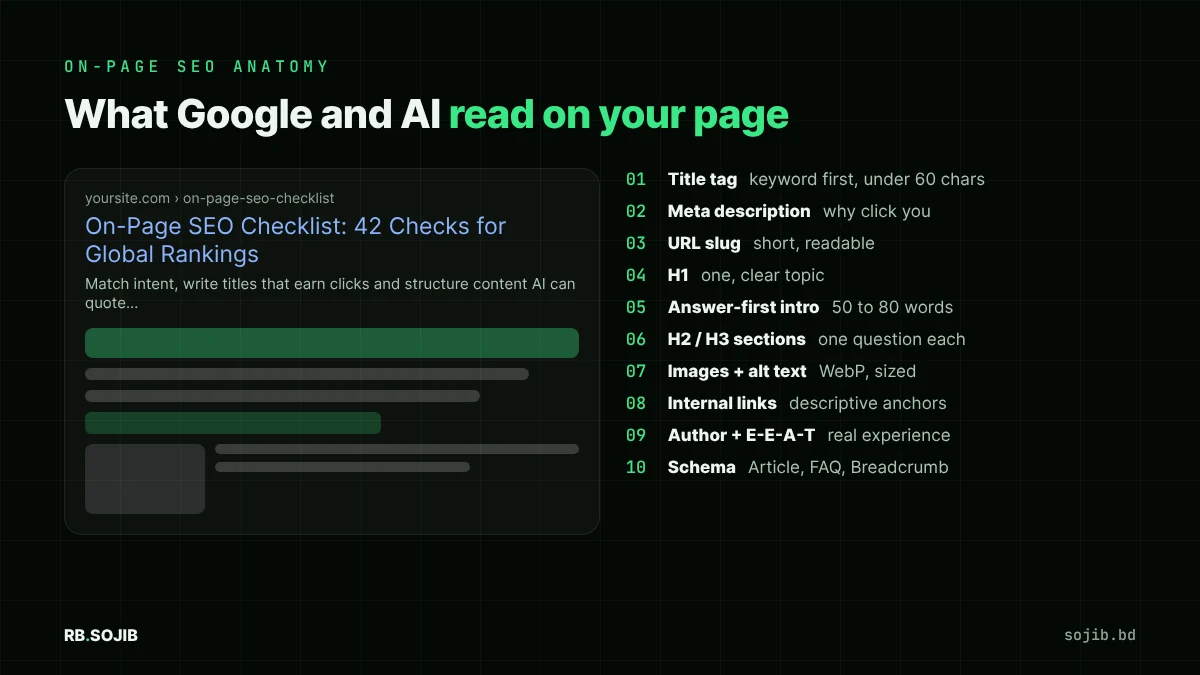
- Title tag under about 60 characters (roughly 580 pixels), primary keyword near the start, plus a benefit or hook. Formula: Keyword: Specific Benefit | Brand.
- Every title is unique. Duplicate titles across pages confuse Google about which one to rank.
- Meta description of 140 to 160 characters that answers “why click this one?” Google rewrites many descriptions, but a strong one still lifts click-through rate.
- Short, readable URL slug with the main keyword:
/on-page-seo-checklist/, not/2026/10/31/post-id=482. - Preview before publishing. My free SERP snippet preview shows how your title and description look on desktop, mobile and social cards.
3. Headings and structure
- One H1 that states the topic clearly and includes the primary keyword.
- H2s for each main question or step, H3s for sub-points. Never skip levels for styling.
- Answer first, then explain. Start each section with a one or two sentence direct answer. AI Overviews and featured snippets quote these opening lines most often.
- Use lists and tables for steps, comparisons and specs. They’re easier to scan and easier for search engines to extract.
- Add a table of contents on long pages, with jump links to each H2.
4. Content quality and E-E-A-T
Google’s quality raters look for Experience, Expertise, Authoritativeness and Trust. AI assistants look for the same signals when deciding whom to cite. You can’t fake these, but you can make them visible:
- Show first-hand experience. Real examples, your own screenshots, results with numbers, mistakes you’ve seen. Generic advice anyone could write ranks worse every year.
- Name the author with a short bio, credentials and a link to an author or about page.
- Cite primary sources (Google’s documentation, official statistics, studies) for any factual claim.
- Be complete, not long. Cover what the searcher needs to finish their task. Cut padding, history lessons and repeated points.
- Show freshness honestly. Display a “last updated” date and actually update the content when facts change.
- Write for humans first. Short paragraphs, plain language, active voice. Read it out loud. If it sounds like a robot, rewrite it.
5. Images and media
- Descriptive file names (
on-page-seo-checklist.webp, notIMG_4482.jpg). - Alt text that describes the image in context, for accessibility first and image search second.
- Modern formats and the right size: WebP or AVIF, compressed, with width and height set to avoid layout shift.
- Original visuals beat stock photos. Diagrams, annotated screenshots and charts earn links and get reused in AI answers.
6. Internal and external links
- Link to the page from at least three relevant pages on your site, using descriptive anchor text.
- Link out from the page to your related guides and service pages, so readers (and crawlers) can go deeper.
- Cite authoritative external sources where they genuinely help. Linking out doesn’t “leak” rankings.
- No broken links. Check with a crawl. My free on-page SEO checker flags broken and redirecting links on any page.
7. Structured data
- Article or BlogPosting on guides, with author and dates. Service, Product or LocalBusiness on commercial pages.
- FAQPage markup for real questions answered on the page. Rich results are limited now, but AI systems still read it.
- BreadcrumbList to show where the page sits in your site.
- Validate with the Rich Results Test. Or generate it error-free with my schema markup generator.
8. On-page SEO for global rankings
Ranking in several countries is where many sites go wrong. Translation alone isn’t localisation, and the same English page rarely ranks equally well in the USA, the UK and Australia.
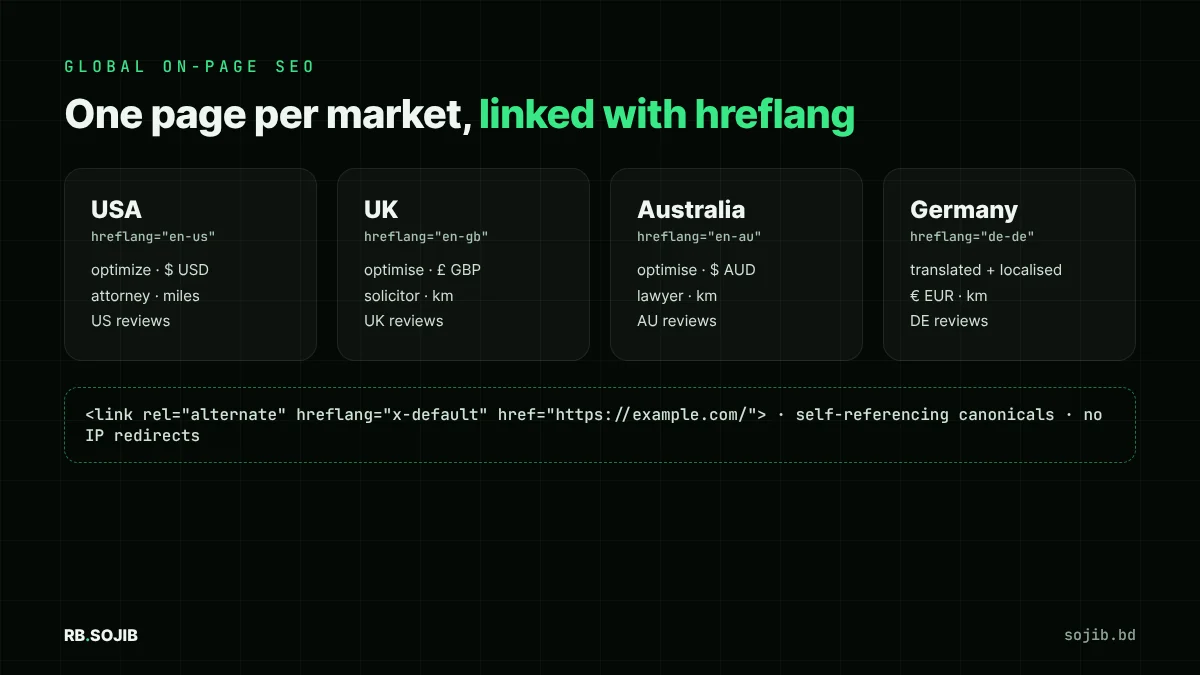
- Use hreflang on every language or regional version, with return links and an
x-default. - Choose one URL structure and stick to it: subfolders (
/uk/) are easiest to manage and share domain authority. - Localise, don’t just translate: spelling (optimise vs optimize), currency, units, phone formats, local examples and local reviews.
- Research keywords per market. Americans search “attorney,” Britons search “solicitor.” Volumes and phrasing differ.
- Self-referencing canonicals on each regional page. Don’t canonicalise every version to the US page.
- Don’t auto-redirect by IP. Offer a country switcher instead, so users and Googlebot (which crawls mostly from the USA) can reach every version.
How AI search engines choose which pages to cite
ChatGPT, Perplexity, Gemini and Google’s AI Overviews don’t rank pages the way the classic results do. They pull short passages that answer a question clearly, from sources that look trustworthy. In practice, the pages they cite most often share a few traits:
- Self-contained answers. A paragraph that makes sense on its own, without “as mentioned above,” is easy to quote.
- Specific facts and numbers with a date, a source or first-hand evidence behind them.
- Clear structure: question-style headings, short lists, comparison tables and definitions.
- Consistent entity details. Your name, business, location and expertise described the same way on your site, profiles and directories.
- Crawlable HTML. Most AI crawlers don’t run JavaScript, so key content must be in the page source.
9. Page experience and conversion
- Fast and stable on mobile (LCP under 2.5 s, INP under 200 ms, CLS under 0.1). My technical SEO audit checklist covers this in depth.
- A clear next step above the fold and at the end: book a call, get a quote, try the tool.
- No intrusive pop-ups on mobile that hide the content.
- Readable typography: 16 px or larger body text, enough contrast and line spacing.
On-page SEO by page type
The checklist applies everywhere, but each page type has its own priorities. This is where I focus first:
| Page type | Main goal | Must-haves | Schema |
|---|---|---|---|
| Blog post or guide | Answer a question fully | Answer-first intro, author bio, table of contents, original visuals | BlogPosting, FAQPage |
| Service page | Turn visitors into leads | Clear offer, proof (results, reviews, logos), process, pricing guidance, CTA | Service, FAQPage |
| Product page | Sell | Unique description, specs, real photos, reviews, stock and price | Product, Offer, Review |
| Location page | Rank in a specific area | Local proof, address or service area, local projects, map | LocalBusiness |
| Homepage | Explain who you are | What you do, for whom, where, and links to key pages | Organization, WebSite |
Worked example: optimising one page
This is an illustrative example: the business is fictional, but every change mirrors fixes I make on client sites all the time. The page was a roofing company’s service page targeting “roof replacement in Dallas.” It was indexed but stuck on page two.
| Element | Before | After |
|---|---|---|
| Title tag | Services | ABC Roofing | Roof Replacement in Dallas, TX: Free Inspection | ABC Roofing |
| H1 | What We Do | Roof Replacement in Dallas |
| Intro | Company history, no answer | Who it’s for, cost range, timeline and warranty in the first 70 words |
| Proof | None | Before/after photos of local jobs, reviews, manufacturer certification |
| Internal links | Linked only from the menu | Linked from the homepage, 6 blog posts and the city page |
| Schema | None | Service and FAQPage |
None of these changes is complicated. Together, they tell Google and AI assistants exactly what the page is about, who it’s for and why it can be trusted. That’s the whole idea of on-page SEO.
Printable on-page SEO checklist
Use it page by page. Your ticks stay in this browser tab until you close it.
On-page SEO mistakes I fix most often
- Two pages targeting the same keyword, so neither ranks well. Merge them or re-target one.
- Titles written for robots (“SEO Services | SEO Company | Best SEO”) instead of for clicks.
- Answers buried under 300 words of introduction. Put the answer first.
- Pages with no internal links pointing to them, invisible to both users and crawlers.
- Translated pages without hreflang, competing with each other across countries.
A simple content refresh routine
Pages slowly lose rankings as competitors publish newer, better answers. Instead of always writing new posts, refresh the ones that already have impressions:
- Find candidates: in Search Console, filter pages with high impressions but average position 8 to 20. They’re close to page one.
- Check the queries: look for questions the page ranks for but doesn’t answer directly, and add short sections for them.
- Update facts, screenshots and examples, and remove anything outdated.
- Strengthen internal links from newer posts to the refreshed page.
- Change the “updated” date only when the content really changed, then request indexing.
Frequently asked questions
What are the most important on-page SEO factors?
Matching search intent, a clear title tag and H1, content that fully answers the query with real expertise, and strong internal links. Those four do most of the work. Everything else refines them.
How long should a page be for SEO?
As long as it needs to fully answer the query, and no longer. Compare the top results for your keyword: if they average 1,500 words of genuinely useful content, 400 words probably won’t compete. But padding never helps.
Does keyword density still matter?
No. Use your main keyword in the title, H1, first paragraph and URL, then write naturally. Covering related topics and questions matters far more than repeating the keyword.
How do I optimise a page for AI search like ChatGPT and Google AI Overviews?
Answer questions directly at the start of each section, use clear headings and lists, show who wrote it and why they’re qualified, and keep facts consistent across the web. Then make sure AI crawlers aren’t blocked. My AI search readiness checker tests this in seconds.
How often should I update on-page SEO?
Review your top pages every three to six months. Check Search Console for queries a page ranks for but doesn’t fully answer, then add those answers.
What’s the difference between on-page SEO and technical SEO?
On-page SEO improves individual pages: content, titles, headings, links and schema. Technical SEO makes sure the whole site can be crawled, rendered and indexed quickly. You need both: a perfect page can’t rank if Google can’t index it. My technical SEO audit checklist covers the site-wide side.
Should I optimise for Google or for AI search?
Both, and luckily it’s mostly the same work. Clear answers, real expertise, good structure and crawlable HTML help you rank in Google and get cited by AI assistants. Write for the person asking the question and both will follow.
Sources and further reading
- Creating helpful, reliable, people-first content: Google’s own E-E-A-T and quality questions
- Influencing your title links: how Google writes and rewrites titles
- Control your snippets: meta descriptions and snippet rules
- Image SEO best practices: alt text, file names and formats
- Localized versions of your pages: hreflang implementation
- AI features and your website: how AI Overviews use web content
Written by RB Sojib, SEO expert in Bangladesh with 7+ years of hands-on work on technical, on-page and local SEO for businesses in the USA, UK, Europe and Australia. I audit and fix WordPress, Shopify and custom sites myself, and every checklist on this site comes from client work, not theory.
168 verified reviews on Fiverr (4.9★) · LinkedIn · Published October 31, 2026 · Last updated November 1, 2026 · Reviewed against Google Search Central documentation
Want your pages optimised by an expert? I’ll audit your top pages, fix titles, content and internal links, and track the rankings with you.