What Is GEO? How to Optimize Your Website for ChatGPT, Gemini and Perplexity

SEO Specialist
- GEO is built on top of SEO, not instead of it. If AI crawlers cannot reach and index your pages, nothing else matters.
- A 2024 Princeton and IIT Delhi study found GEO techniques can lift a source’s visibility in AI answers by up to 40%.
- Adding statistics, quotations and cited sources worked best in that study. Keyword stuffing performed worse than doing nothing.
- Lower-ranked sites gain the most: citing sources lifted visibility by 115.1% for pages ranked fifth in normal search.
- Each AI engine has its own crawler. Allow OAI-SearchBot (ChatGPT), PerplexityBot (Perplexity) and Googlebot (Gemini and AI Overviews).
What is Generative Engine Optimization (GEO)?
Generative Engine Optimization (GEO) is the process of making your content easy for large language model (LLM) search tools to retrieve, understand and quote. When someone asks ChatGPT “who is the best SEO expert in Dhaka?” or asks Google “how do I speed up a WordPress site?”, the AI does not show ten blue links first. It reads several web pages, writes one answer, and links to a few sources. GEO is the work you do so that your page is one of those sources.
The term was introduced in a research paper titled “GEO: Generative Engine Optimization” by researchers from Princeton University, IIT Delhi and independent collaborators. It was published at KDD 2024, one of the leading data-mining conferences. The authors built a benchmark of 10,000 queries and tested nine ways of rewriting content to see which ones made AI engines mention a source more often.
In plain words: SEO gets you ranked. GEO gets you quoted. You still need both, and you can read my full comparison in SEO vs GEO vs AEO: what’s the difference?
Free, with a written report.
Get my free auditWhy GEO matters for your business in 2026
AI answers are no longer a side experiment. They sit at the top of the search results that your customers see every day.
- Google AI Overviews reached about 2 billion monthly users across 200 countries and territories, according to Google’s figures reported by TechCrunch.
- Google AI Mode passed 1 billion monthly users and the Gemini app reached about 950 million monthly users, based on Alphabet’s Q2 2026 update as summarised by Scalevise.
- Microsoft now shows site owners how often Copilot and Bing AI answers cite them, through a new AI Performance report in Bing Webmaster Tools launched in February 2026 (Search Engine Land).
When a buyer gets a complete answer from AI, they often click only the sources named inside it. If your competitor is cited and you are not, you lose that visit even if you rank on page one. For small businesses in Bangladesh and abroad, this is also an opportunity: the GEO study showed that well-structured pages from smaller sites can win citations against bigger brands.
How AI answer engines choose which websites to cite
Most AI search tools follow the same basic pipeline. Understanding it tells you exactly where to optimize.
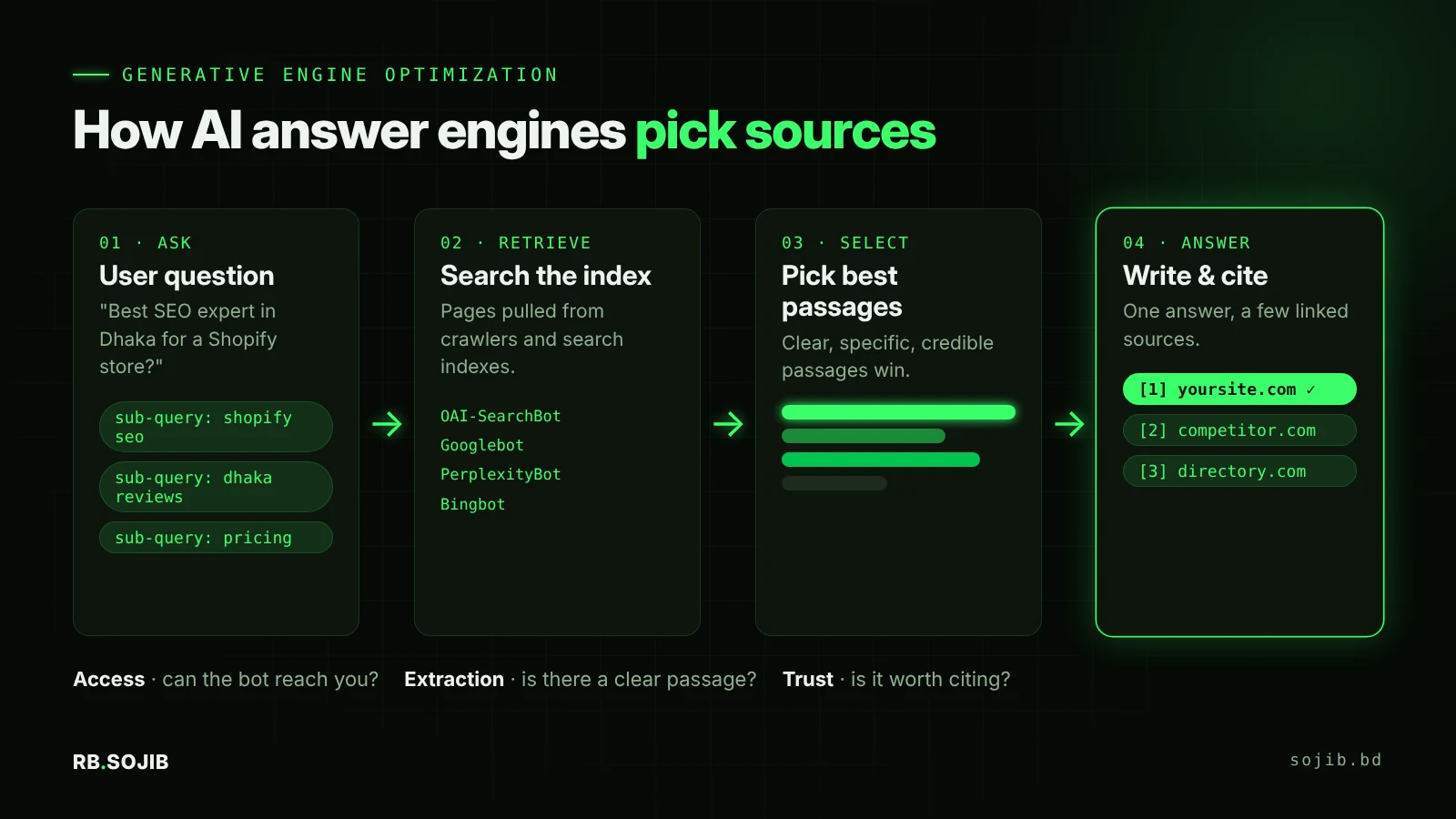
- Understand the question. The AI rewrites the prompt and often splits it into several smaller searches. Google calls this “query fan-out” in its AI features documentation.
- Retrieve pages. It pulls candidate pages from a search index. ChatGPT uses OpenAI’s own crawler plus outside search providers, Gemini and AI Overviews use Google’s index, and Perplexity uses its own crawler.
- Pick passages. It reads the pages and keeps the short passages that answer each sub-question most clearly and credibly.
- Write and cite. It composes one answer and links to the pages it relied on.
So GEO works at three levels: access (can the bot reach and index your page?), extraction (is there a clear passage it can lift?) and trust (does the passage look credible enough to cite?).
The 6-part GEO framework I use on client sites
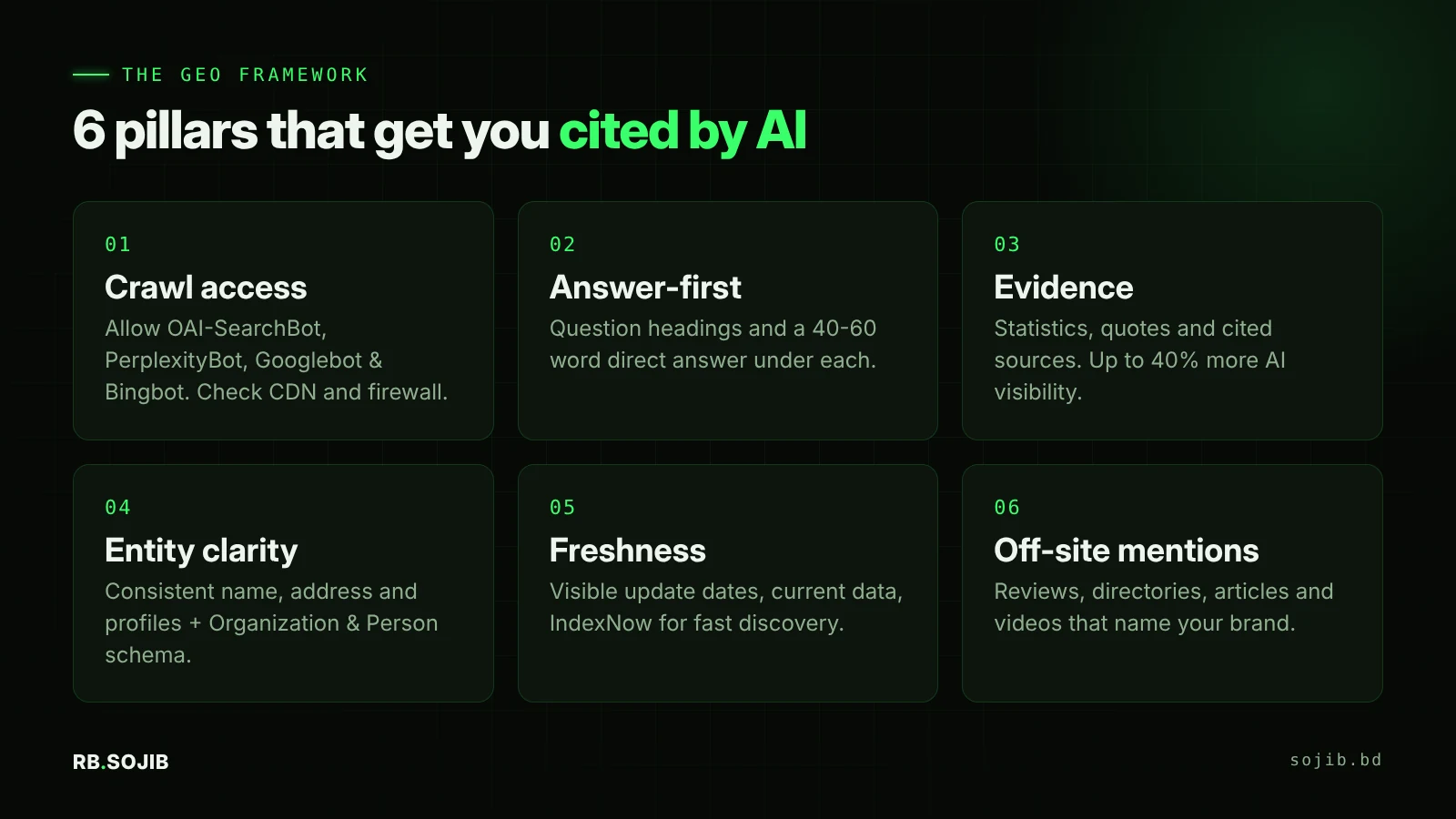
1. Give AI crawlers access
Every AI engine needs its own bot to reach you. Check your robots.txt, your security plugin and your CDN or firewall (Cloudflare often blocks AI bots by default). The bots that matter for visibility are:
| AI engine | Bot to allow | What it does |
|---|---|---|
| ChatGPT search | OAI-SearchBot | Finds pages to show in ChatGPT search answers |
| OpenAI training | GPTBot | Collects content for model training (optional, separate choice) |
| Gemini, AI Overviews, AI Mode | Googlebot | Normal Google crawling and indexing |
| Perplexity | PerplexityBot | Finds pages to show and link in Perplexity answers |
| Copilot | Bingbot | Normal Bing crawling and indexing |
OpenAI states in its crawler documentation that sites which block OAI-SearchBot will not be shown in ChatGPT search answers, and that robots.txt changes can take about 24 hours to apply. If you are not showing up there, start with my checklist: Why is my website not appearing in ChatGPT search?
2. Write answer-first content
AI engines lift passages, not whole pages. Make each section easy to lift:
- Use a question or clear topic as each H2 (for example, “How much does a WordPress website cost in Bangladesh?”).
- Answer it in the first 40 to 60 words directly below the heading.
- Then expand with steps, lists, tables or examples.
- Keep one idea per paragraph and define terms in a single, quotable sentence.
3. Add evidence: statistics, quotes and sources
This is the part most backed by research. In the Princeton GEO study, Statistics Addition and Quotation Addition gave strong gains, and including citations, quotations and statistics significantly boosted source visibility. The best methods improved visibility by about 40% over unoptimized content. Classic keyword stuffing scored below the baseline.
4. Make your entity clear
AI needs to know who you are before it recommends you. Use the same name, address, phone, services and social profiles everywhere. Add Organization or LocalBusiness, Person and Article structured data so machines can connect your pages to your brand. I explain which types matter in Does schema markup help AI search?
5. Keep content fresh
Microsoft’s Fabrice Canel has said generative AI values fresh content in particular and recommended IndexNow so search engines learn about updates quickly (Search Engine Land). Show a visible “last updated” date, refresh statistics every few months, and enable IndexNow (Rank Math and most SEO plugins support it).
6. Earn mentions outside your site
AI engines cross-check. If reviews, directories, industry articles, YouTube videos and forums mention your brand next to your service, AI is more confident naming you. Keep your Google Business Profile complete, collect reviews, and contribute expert answers in your niche.
How to optimize for ChatGPT, Gemini and Perplexity
The framework above works everywhere, but each engine has its own entry point.
ChatGPT
- Allow OAI-SearchBot in robots.txt and in your firewall.
- Submit your site to Bing Webmaster Tools too. Research by Peec in September 2026 found ChatGPT search pulls from OpenAI’s own index plus several outside providers, including Google and Bing-related data, so being well indexed in both helps (Peec research).
- Publish clear comparison, pricing and “best X for Y” content, which ChatGPT often uses for recommendation questions.
Google Gemini and AI Overviews
- Google says there are no extra technical requirements. A page must be indexed and eligible to show a snippet in Google Search.
- Focus on helpful, people-first content, strong internal links, good page experience and structured data that matches the visible text.
- Full guide: How to rank in Google AI Overviews in 2026.
Perplexity
- Allow PerplexityBot. According to Perplexity’s documentation, it respects robots.txt and changes can take up to 24 hours.
- Perplexity rewards recent, well-sourced pages. Date your content and cite primary sources.
How to measure GEO results
- Google Search Console: AI Overviews and AI Mode clicks are counted inside the normal Performance report under the “Web” search type.
- Bing Webmaster Tools, AI Performance: shows total citations, cited pages and grounding queries for Copilot and Bing AI answers.
- GA4 referrals: create a segment for sources like chatgpt.com, perplexity.ai and gemini.google.com.
- Manual prompt tracking: each month, ask ChatGPT, Gemini and Perplexity 10 to 20 questions your customers ask, and record whether you are cited.
GEO mistakes to avoid
- Keyword stuffing. It reduced visibility in the GEO study.
- Blocking AI search bots by accident through a security plugin or CDN setting.
- Hiding key answers in images, PDFs, sliders or tabs that load by JavaScript.
- Relying on llms.txt alone. Ahrefs data reported by PPC Land found 97% of llms.txt files received zero requests in May 2026. It does no harm, but it is not a ranking lever.
- Thin AI-written content without first-hand experience, data or examples. AI engines have little reason to cite a page that repeats what they already know.